Showing posts with label film reviews. Show all posts

Wednesday, January 4, 2012

Sherlock Holmes: Game of Shadows

I just watched the latest incarnation of the Sherlock Holmes saga, this in the form of the second film staring Robert Downey Jr. in the namesake roll. I had very much enjoyed the first film that he did, and this was, if anything, even better. Jude Law reprised his role as the good Doctor Watson, with a character far more capable than he is often made out to be. Most amusingly cast was Stephen Fry as Sherlock Holmes’ “older, smarter brother” Mycroft. Per the rest of the cast, they were quite competent actors all but since I hadn’t heard of any of them before I’ll pass on mentioning them, so there it is.

Since my reviews are always about the cool stuff, however, I’ll leave all that acting criticism for others (who as usual pan what I like and like what I pan, but again, there it is. They get paid for it and I don’t, so perhaps they’re on to something I’m ignorant of).

As usual, whoever does the props and armouring for these movies knows what they’re doing, and they do it well. From the credits it looks to be a lot of folks, but I give real kudo’s to whoever is actually in charge of the over-all look, be that the Director Guy Ritchie or the head of his Props department, or whoever. Everything looks great! Buildings, backgrounds, set dressing, props, weapons, clothing, background artists, you name it, and it not only was high quality, but it looked like it belonged there, and in fact looked like it grew there (even some of the clothes on some of the actors looked as though they’d been on them long enough to have enough extra passengers and life-forms to begin new planets). Well done on their part.

Minor Spoilers Ahead

Okay, the Cool Toys. They have them, and lots of them. In the first scene in which Holmes has to fight his way clear of things, one of the thugs he deals with has a nice little Webley top-break .38. Sadly (from what I could see, I could be wrong on this one) it was one of their post-WWI models of this size, but what the heck, Webley DID make such a beast in the late-1880’s, so it’s fine.

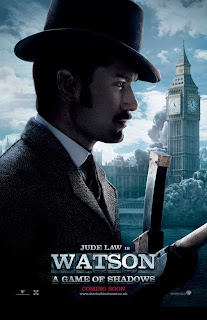
As usual, Watson is carrying his trusty Webley RIC. This being one of the later models, it was probably in .455” rather than the somewhat less powerful .450”. Speaking of Watson, there was a bit of a time disconnect going on in this film, since Watson is supposed to be fairly recently returned from Afghanistan (the 2nd Afghan War taking place between 1878 and 1880), and yet there are weapons which hadn’t been invented until the mid-1890’s, but, oh well. Most are close enough. I rather liked the little single-shot derringer which Holmes hands to him on the train, too. Looked like it was a Colt .41” rimfire, but hard to tell: still, cool.

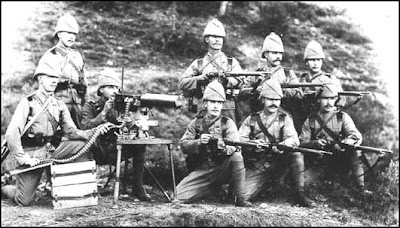
The bad-guys on the train have, of all things, a Model 1889 Vickers-Maxim Machine Gun, in caliber .303”. How cool is that? Brass water jacket, brass receiver, lots of brass everywhere! Unfortunately the cartridges they were using in the belt were the post-1905 Mk VII Ball, rather than the Mk I Ball (black powder with a 220-grain round-nosed bullet, rather than cordite powder and 174-grain “spitzer” bullet) they should have been using. Oh well; details, details...but that's what I'm all about, so I'll mark them down on that one.

The bad-guys on the
train have one other interesting piece though, and that is their “close-in” weapon, at least the one with which they try to kill Our Heroes at close range. For whatever reason, one is carrying a Model 1887 Winchester Shotgun with a short “riot” barrel on it. What? Brit’s just don’t go for such things in shotguns. Isn’t sporting, you know, it must be a double or nothing. You might have been able to buy such a thing in Londo n, but, Goodness! Even as a murder weapon: just not done. I like them though, so it gets points from me.

I do have to take serious issue with one thing on the train though: The British “soldiers” have a nice box full of stick-mounted “Mills Bombs”, AKA hand grenades. Considering that these had gone out of fashion during the American Revolution and didn’t come back until the trenches of 1915 made such things desirable (the first ones were made from jam tins filled with artillery explosives and tied to sticks), it would be hard to imagine the British Army (or fellows posing as such) having such things in 1890. On the other hand, they’re cool and it
does keep the story moving.

Chasing around Paris is always fun, especially if you get to shoot
at folks while down in the sewers, so what else to use but a proper French military revolver? Indeed, they have them! At least Watson does, picking up a Mle. 1892 Lebel 8mm revolver up from a fellow with no further use for it, and using it to good effect. Later he somehow even gets one (or perhaps it’s another sort, but close) with ivory grips which is particularly fetching. Watson always gets the cool guns, I have t o say.

The sniper rifle belonging to the henchman of Arch-Nemisis Moriarty has exactly what one might expect of a former British soldier: a Martini-Henry, though in a somewhat smaller caliber (which is fine) than the original .577/.450 cartridge for which it was designed. It looked almost like the semi-experimental .400” cartridge that the British Army almost adopted, but chose instead to go with the more efficient .303” for their new magazine rifles in 1888. However, there is one scene in which the henchman fires off several rounds in quick succession at Watson, something which simply cannot be done successfully with a Martini-Henry. Shades of a Dallas Deer Rifle, I’m afraid.

On the other hand, the scenes in Germany are great, with plenty of cool firearms to bedazzle the e ye, from the 7.63mm Mauser “Broomhandle” pistols (AKA “C-96” after the year of introduction. See my problem here?) to the 105mm (or was it a 155mm?) Krupp artillery pieces.

There is, however,
a “minor” issue with regards to the Broomhandle Mausers. This will take awhile, so sit back and relax.

The henchman notes to Holmes that these unusual pistols are the latest thing, far more modern and thus better than the revolver he is carrying, and possesses a 10-round magazine: all well and good. Then he tosses a clip to Holmes, which h e pulls from a case of such things, to charge the Mauser. From what I could see (and I may have seen what I was expecting, too) he tossed a “charger clip”, being a thin sheet-metal piece which only holds the rim of the cartridge (which is right and proper for a Mauser C-96 ), but then they both slap the floor of the magazines of their pistols as though they had in fact placed fresh magazines into their respective pistols. So, here’s the problem. Mauser didn’t begin to manufacture a model capable of such replaceable magazines until the 1930’s, following the lead of some Spanish copyists. Much of the problem is really a problem with usage of terms. Any more these days, people interchange “clip” and “magazine”, when in fact they are very different beasts. A f irearm may in fact be able to use both, or neither, or one or the other, but they are not at all the same thing. As noted, with a Mauser the clip holds the rims of the cartridges and they are then “stripped” into place (thus sometimes being referred to as “stripper clips”). A magazine, on the other hand, holds the entire cartridge, along with several others, and may be an integral part of the firearm (as in the case of the Mauser) or may be removable, as is the case with almost all modern military firearms. Th ese are generally made of thin sheet metal and contain anywhere from five to 100 cartridges, and can be removed at will by the user. To confuse you even more, there are the “en-bloc clips” such as developed by Mannlicher and later used in the famous US M1 Garand rifle, wherein the entire clip holding the cartridges is fed into the magazine and then ejected.

With me so far? Right; so when the henchman an d Holmes slap the magazine floors of their pistols, it would do nothing other than to make
noise, and not much of a noise at that. The ONLY WAY to load a C-96 “Broomhandle” Mauser is with a stripper clip from above, with the bolt back. That’s how they were designed, and the later version was in fact capable of fully-automatic fire and usually had a 20-30 round magazine. The whole scene is to let the dolts who think that Gangsta moves are cool know that they had loaded the pistols, and then of course the henchman proceeds to turn his pistol to a 90º angle and hold it at Holmes’ head, just like a Gangsta. Okay, now all the Gangsta’s in the audience know that he’s loaded his pistol and is going to shoot it. Joy.

All right, I’m done ranting. I’ll point out that Winston Churchill packed one of these cool Mauser pistols in the Battle of Omdurman in 1898. They were in fact quite popular with British officers of the day, so it’s cool that the film includes them. But, come on, at least load them properly! (Oh sorry, I said I wasn’t going to rant any more on that one. Oops.)


I think that they rather made up for it, however, with the massive use of the usually-forgotten German Gewehr (just means “rifle”) 88, usually shortened to Gew. 88 or G-88, and sometimes known as the “Commission Rifle”. As the nickname implies, it was designed by a commission, and like the commission that came up with the camel, isn’t exactly what was ordered when the Imperial German Army asked for a horse. The Germans had adopted a product of the genius of Peter Paul Mauser in 1871, and again in 1884 with the Gewehr 71/84, a modification from single-shot to magazine-fed (this magazine being of a tubular variety, under the barrel as with a Winchester). However they tired of paying Mauser the royalties on his patents and decided to go around them, using a pinch of Mauser here, a dash of Mannlicher there (it used a 5-round “en-bloc” clip) and to top it of, a strange sheet-steel barrel jacket which was supposed to dissipate heat from the barrel, but instead tended to attract moisture and cause rust. When Mauser showed up with his much-improved Model of 1898, the German Army was more than happy to put their Commission Rifles into the hands of the second-line Landswehr troops and step up to a much better rifle, one which became the standard by which all others were judged for better than 50 years. Anyway…

The poor old Gewehr 88 performs sterling service in this film, both in the hands of the good guys and the bad guys. Dr. Watson in fact manages to shoot the henchman and wound him with his at a pretty decent range, something which the rifle was well capable of. Since one of the good things about the G-88 was that it introduced the famous 8X57mm Mauser cartridge (Mauser got his revenge there, since he didn’t actually design that round. Besides, it’s really a 7.92mm, or 7.9mm according to the German Army. The 57 stands for how many millimeters long it is), a round which was destined to give birth to virtually all of the military and sporting cartridges of the 20th Century. Even the American 30-06 is a variant, as is the modern 7.62 NATO round.

At any rate, the G-88 and the 8mm cartridge proved to be quite a serviceable combination, far superior to the French 8mm Lebel which it was designed to counter. (In 1886 the French had astounded the world by introducing the first smokeless cartridge, the 8mm Lebel, along with a rifle to go with it. The cartridge was revolutionary, the rifle pedestrian with no mechanical improvement over the German 71/84, but of course the French hung on to it until almost WWII while everyone else went on to much better things, the G-88 being one of them. The Germans, being the premier chemists of the day, weren’t about to let those darned Frenchies get away with stealing a march on them, so they came up with the 8 (or 7.9)X57 cartridge, a rimless bottleneck round which, as I noted above, was the progenitor of most of the military and sporting cartridges of the 20th Century.

Both good and bad guys make excellent use of these venerable old rifles, and I’m willing to bet that this is one of the few films ever made which features them in it. You occasionally see a Broomhandle Mauser here and there (“Young Winston”, for example), or Webley RIC’s (“The Wind and the Lion”), or even 1887 Winchesters (“Terminator II”). Commission Rifles? Not so much. So that’s another point for the film.

I’m not much up on heavy artillery, so other than to say that they looked more like the WWI “Gustav” siege pieces made by Krupp than anything else, and that I think that they were designed in the 1890’s, I’ll give them a pass.

On the other hand, one of the weird “pocket artillery” pieces they used was definitely not around in the 1890’s, or even in the next decade, and that was the “Meinenwerfer” that the bad guys were using. Think “Trench Mortar” with wheels and you’ve got it. On the other hand, I doubt seriously that anyone since the making of “All’s Quiet on the Western Front” has had one in their movie, so what the heck. Maybe the TNT film “The Lost Battalion” with Rick Schroeder? Maybe not even then.
The final cool and wonderful thing is the rather odd “sub-machine gun” with which Dr. Watson arms himself in the German arms factory. What on earth it was supposed to represent is a bit of a mystery, though I have a few ideas.

To begin with, it’s obviously not firing full-sized rifle ammunition, as the top-mounted magazine (real magazine, not a clip, remember!) wasn’t nearly long enough to hold a full-caliber round. On the other hand, such a thing hadn’t been invented yet (though John M. Browning’s first experimental auto-loading pistol, in 1897 went full-auto on him when he tried it out, because he hadn’t thought of a “disconnector” which disconnects the trigger from the hammer sear. See, it’s actually easier to make a fully-automatic weapon than a semi-automatic one, so all of the laws on the books about such things are flat silly.) On the other hand, there is just possibly something that would almost fit the bill, that being…the Danish Madsen machine gun of 1902. The original patents were from 1899, so it does kind of qualify as a 19th Century machine gun, but what Dr. Watson was carrying isn’t precisely a Madsen, either. It looks like a strange bash between a Colt-Browning Model 1895 “Potato Digger” (wonderful name, what? But not something you would want to shoot off-hand), the Madsen and the Italian Villa-Perosa of 1916. Both of the later used the curved, top mounted magazines shown in the film, and the Villa-Perosa used the rather under-powered Italian 9mm rimless cartridge, but hey, it’s only a movie.

I do have to say, though, that the Madsen was one of the wonders of the world, mechanically speaking. Rather like a bumblebee, it really shouldn’t work, since the cartridge should have to “bend” to get from the magazine into the chamber. But they work like a champ, enough so that they’re still in use by Brazilian police when shooting up the slums of Rio. Talk about longevity, they haven’t made a new one since the 1940’s, but they’re still on the job.

Last but not least, I have to mention a quick cameo appearance by the immortal Gatling Gun as well, merrily firing black powder loads at our intrepid heroes. Gotta love it when a scene has firearms spanning half-a-century or more in it, all being used with equal abandon! Makes me feel all gushy inside, I must say.

All told, it’s a really good film from my perspective, with lots and lots of really cool, really arcane, weird and wonderful weaponry in it. Even the Cossack has a cool middle-Asian dagger! They trot out all sorts of unlikely and uninvented pieces for us to enjoy, very Steampunk in that regard, and quite fun. Definitely doing some “anachronisms” of technology by a few years, but it’s not a documentary, so why not? It’s fun, and definitely worth the price of admission. I know I’m planning on getting a copy when it comes out on DVD just so I can see what cool stuff is in the background that I missed!

Cheers!

Gordon

* The last instance I can recall off-hand of their use was when an American sailor dropped one from the rigging of the Bonhomme Richard on to the deck of HMS Serapis, where it landed in a box of British hand-grenades and pretty much decided the battle. This was in 1778

.

Friday, January 7, 2011

True Grit

I just watched the new film "True Grit" this afternoon, and I am quite impressed with it. Not a "remake" of the 1969 John Wayne film of the same name, but rather a different adaptation of the book into film. The Coen Brothers did a remarkable job in bringing the book to life, and giving the characters a much earthier, more complex depth than the earlier film ever could have done.

Jeff Bridges as Reuben "Rooster" Cogburn does a great job of portraying a down-at-the-heels US Marshal from "Hanging Judge" Parker's court in Fort Smith Arkansas in the 1870's. Not by any means a "nice guy", but rather a former partisan ranger from the Civil War who had ridden with Quantrell at Lawrence, Kansas and probably performed some rather bloody work in the process. A man of few scruples and less patience when it comes to dealing with others of his ilk, he's a hard man, but also one who has the heart to do his absolute utmost to save the young girl's life when it's endangered. His armament of a pair of "Navy Sixes" is most interesting, being his outfit from his Civil War days carried as spares in pommel holsters on his saddle. (Of course they're not actually .36 caliber Navy Colts, but rather the larger .44 Caliber Dragoons, as they are definitely visually more impressive than the smaller, and smaller caliber, Navys.) His primary armament consists of the more modern "cartridge guns", a Colt Single Action Army revolver (probably in .45, one would imagine) and a Winchester '73 Rifle in .44 Winchester Center Fire (Colt had just begun chambering it's revolvers in .44 WCF the year before, so it's doubtful that Mr. Cogburn had managed to get his hands on one so quickly, but you never know).

Mat Damon's character, Le Boef, the Texas Ranger, is rather amusing in many ways. Dressed in rather outlandish getup for Arkansas he styles himself, rather, as a "buckskin cavalier", but is quickly put in his place by young Maddie Ross, the protagonist of the story. She points out that he looks more the "circus clown" than an officer of the law. What is quite nice about this is that he IS dressed outlandishly for that place, but it's a completely, totally period outlandishness which wouldn't have seemed nearly so out of place further West, say in the Rockies or Western Canada, but in Fort Smith Arkansas not so much. By the way, his Sharps Carbine is completely appropriate for a Texas Ranger, as they were issue pieces during the mid-1870's from the State of Texas which was using former US Cavalry weapons.

Maddie (Hailee Steinfield) of course carries her father's cap-and-ball "Colt's Dragoon", a large revolver which constituted Samuel Colt's first major commercial success in 1848-1861's production. Using the same frame as the larger Colt's Walker revolver (1847) purchased by the US Army and issued in the fading days of the Mexican War, the Dragoon is what made Colt a household name throughout the United States (though it was the smaller, handier Navy Model of 1851 which made Colt a household name throughout the world.) Never the less, it would be quite possible for Maddie to have carried such a revolver, it being her father's property, on such an occasion. Though outmoded by the more modern cartridges which had come out in the past 10 years or so prior to our story, it was still considered to be a powerful, reliable side-arm. Though somewhat slow to load due to it's use of "loose ammunition" (powder, ball and cap all placed within or on the cylinder separately) and therefore also somewhat less reliable than cartridges, it was still very much a deadly firearm, and for the first six shots the equal of anything then manufactured. Still is, in fact.

The only other firearm of note is the Remington Model of 1875 Army revolver which Ned Pepper carries. It's nice that he has emblems from playing cards on the grips, indicative of his sobriquet, "Lucky" Ned Pepper. (I also found it amusing that the actor who portrayed "Lucky" Ned Pepper shared the character's last name, he being Barry Pepper. Rather neat.) By the by, his "wooly chaps" were great! Perhaps not a common item in the Indian Territory in the 187o's (being more of a Northern Plains 1880's and later phenomenon) but from the point of view of defining the character from his comrades, quite brilliant. Besides, they LOOK very, very cool.

The horsemanship of the film wasn't too bad, and the horsemanship of Hailee Steinfield is superb. The girl can ride! Good for her, and good for the Coen Brothers for actually casting a girl who can not only act up a storm, but also ride like she was born in the saddle! Bully for them! Also the horse tack was great. Definitely of the period. Perhaps a bit new, perhaps a bit too "cowboy" for some of the characters, but definitely saddlery that was available in the time and place, and therefore further kudo's to the producers and their props and wrangler departments.

One of the things I have to also remark upon is that the shots fired SOUND like real shots being fired from a black-powder weapon, be it cap-and-ball or cartridge. The big, hollow "Whumph!" sound rather than the sharp crack of the modern smokeless blanks that had been so often used (or rather Foleyed in later) is proper, and to me at least adds a great deal to the "feel" of the film.

So there it is. An excellent film, a wonderful Western, and a great character study of people who have determination and indeed, "True Grit".

Cheers!

Gordon

Sunday, April 12, 2009

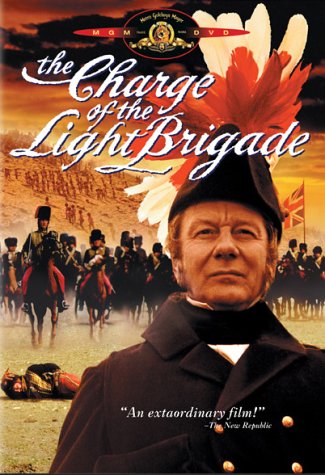
Charge of the Light Brigade

I just finished watching the 1968 film production "Charge of the Light Brigade", directed by Tony Richardson. Beautifully filmed, it's a very odd movie, and of course with it's strongly anti-war sentiment it's bloody and shows battle to be ugly business. Unfortunately it's also very disjointed and quite hard to follow. I actually know what is supposed to happen and when, but even then it's hard to figure out just who is who and doing what and why. Small wonder then that the critics, who Richardson had blasted as "intellectual eunuchs", panned the film. But the worst of the travesties committed by Richardson in this film was that he insisted, for "creative purposes", to fly in the face of all of his advisers and put ALL of the British Light Cavalry, not just the 11th Hussars, in "Cherry Pickers" or "Cherry Bums" trousers. The 11th Hussars were the only regiment in the British Army with crimson trousers (everyone else wore blue), and thus really stood out in a crowd. But for whatever "creative" reason Richardson had, he insisted that ALL of the British Light Cavalry be so attired. Didn't make the members of any of the other regiments who had supported the making of the film very happy, either. Oh well. Interesting film to watch, even though it's often painful at times to endure.

The reason for my watching it is that I just picked up a new book on the subject, entitled "Into the Valley of Death: The Cavalry Division at Balaklava 1854" by none other than John Mollo (with his brother Boris), the gentlemen who had done so much of the research on the uniforms worn by the British forces at the time. So the research did at least result in a fascinating book, well illustrated not only with original paintings and photographs but also modern interpretations of the uniforms as well. Of note are the many sketches drawn on the spot by the French General Vanson, now housed in the musée de l'armée in Paris. Those sketches themselves are worth the price of the book, actually.

At any rate, John Mollo does rant a bit about Tony Richardson's handling of things in his forward, which definitely made me want to watch the film. Alas, though beautiful, it is disappointing in the end. Too bad, it had huge potential.

On the other hand, it has enthused me further to complete my own studies on the dress and accoutrements of British Hussars of the period. So on I go, delving further and further into the quicksand of research, from which hopefully I shall emerge eventually not only unscathed but fully dressed, armed and accoutred as a Serjeant of the 15th (King's) Light Dragoons (Hussars) in a few month's time!

Cheers!

Gordon

Monday, October 6, 2008

Appaloosa (The Movie, Not The Horse)


I usually don’t use the term “Superb” to describe movies, since I generally much prefer to work on them than watch them, but I have to say that Appaloosa, starring Ed Harris and Viggo Mortensen, is just that: Superb. My wife and I just got back from watching it this afternoon, and I was totally blown away by not only the skill of the director, cinematographer and the stars, but also the props, hair & makeup and costume people as well. Usually it’s in the Hair & Makeup department that things go south in period pieces, but they actually did a great job on this one. Even when background people may be just right, the Stars are usually seen in some horrid contemporary hair fashion that may look right to the modern viewer, but clashes with the period being done, and in 20 years will look downright silly. Not this time: it looks good.

Likewise the clothing. Even Renee Zellweger’s clothing is spot-on, down to the underwear (yeah, you get to see some of that, too). The men’s clothing is great, what with vests and ties everywhere. The boots were good two-piece boots of the period, and the spurs were the fine “California” rowel spurs of the day, not the clunky “Western Spurs” that are worn now-a-days. And the HATS! My God, they are GREAT! All sorts of hats of the period, but best of all is Viggo Mortensen’s hat, it is GREAT! I’m officially jealous of THAT hat.

Props did a fine job with the gunbelts, saddles, you name it, and the Armourer outdid himself. From Viggo’s 8-gauge double shotgun (them things are BIG, and his was indeed a bloody big shotgun!) to the fact that his carbine (1866 Winchester) and his pistol (1872 Colt “Open Top”) fire the same ammunition (.44 Henry Flat), thus making them very serviceable together. Ed Harris’ combination of a pair of 1873 Colt Single Action Army’s and a Winchester 1873 Short Rifle was nice too: again, they easily could be in the same caliber, since Colt brought out their SAA in .44 Winchester Center Fire (aka .44-40) in 1878, and the story takes place in 1882. Plenty of time for Harris’ character to pick those up, while Viggo Mortensen’s character would still be considered well armed. Heck, one guy even had a Spencer carbine! Little details like that make me all warm and fuzzy inside.

Other details were absolutely wonderful, for instance after one of the shoot-outs, which happens in the blink of an eye. Viggo says to Harris “That was fast”. Harris answers “Everybody could shoot!”. Most gunfights were that fast, none of this long, drawn-out Hollywood gunfight stuff, and this was true to life, at least when depicting professionals. A fair amount of lead flying, lots of blood, and not much time elapsing. Thank God Harris (the Director as well as Star, Writer and Producer) chose not to “Sam Peckinpaugh” us with morbid shots of slow-motion carnage. Fast and furious, then over.

The story itself was very well played out. Subdued, really. It’s a buddy story, with the girl who comes between them, but it’s not done the way one might expect. The two main characters of Virgil Cole (Ed Harris) and Everett Hitch (Viggo Mortensen) are long-time partners. They don’t talk a lot, and don’t need to either. Lots of looks, a few words, and deep understanding of how the other man works is all there for the viewer to see. It’s the way films are SUPPOSED to be done, without a lot of talking. SHOW ME, don’t talk me to death, and this is exactly what Harris does in this film. He shows, doesn’t talk.

There is a lot to be said for this movie, and I really can’t think of a single bad thing to say about it, which for me is highly unusual to say the least. But I think that the very best thing I can say is that in the very last scene, with Everett standing in his “Shootist” stance, he looks straight out of Frederick Remington’s paintings, and is absolutely perfect in stance, clothing, weaponry, hair, you name it. On this, higher praise I cannot possibly give. He looked “Right”.

Gordon