Showing posts with label cavalry. Show all posts

Sunday, April 3, 2016

Chasing Pancho Villa: supplement to History Files episode 47


This is the blog post to go along with both our History Files episode 47 on the Border Raid on Columbus New Mexico in 1916 by Pancho Villa. Here are a few photos for your enjoyment.


This photo shows what a real cavalryman looked like in 1916 or so, with his M1911 pistol in it's M1912 mounted pattern holster, and the mounted pattern Mills Belt. As you might notice. there are two different types of pistol ammunition pouches on the front of the belt, one for magazines (on the soldier's left side) and one for loose ammunition (on the soldier's right side). Originally the belt was set up for loose ammo on both sides, but the left hand side's tabs have been removed, and replaced with a magazine pouch, model of 1912 carrying two 7-round magazines.

This photo is of Major Del Berg, with me at Camp Parks in California. Technically we're portraying the 11th Cavalry ca. 1942, but it's not like the Cavalry changed a whole lot during the inter-war period.  We're holding our M1911 pistols at the "ready" (but I'm not paying proper attention! My horse, Twister, was being a bit of a handful at the time, as I recall.  Not that this was unusual for him...but he did know his drill!)
This photo too is technically a bit late for 1916, as I believe it is ca. 1930 or so, but it shows the proper packing of the M1904 McClellan saddle. This is, as the notation suggests, a photo of the "near side" of the horse, the other side being the "off side". You may notice that, just behind the horses front legs is hanging down the scabbard for the M1913 "Patton" sabre.  While useful to counterbalance the weight of the M1903 Springfield rifle on the near side, they were deliberately left in barracks by the cavalry troopers who chased after Pancho Villa due to the excess weight, and the assumed lack of need for a sabre when chasing what were essentially a bunch of cowboys through the desert.


This photograph shows my Grandfather's encampment, part of the 7th California National Guard Infantry, on the road to Nogales, I believe. Note the horses and wagons in the foreground.  The US Army was still largely horse-drawn in 1916.
Goofing off


In another photo by my Grandfather, a field-grade officer (since he's set up for riding a horse, with his saddle, saddle-bags, boots and spurs, and in an Infantry unit only the field-grade officers rode horses) is shaving with his straight-razor in what passes for a tent. Note the canvas water buckets near the tent-pole. 
Practicing an assault up-hill. If you take careful note, their gear is a mish-mash of equipment from the past 20 years prior..

7th California NG Infantry on the march, with the mounted field-grade officers in front. The lead horse is obviously a private-purchase officer's mount, as the Army really, really didn't like to buy horses with four white "stockings". BTW, the above original photo's were taken by my Grandfather Herschel G. Frye Sr., while in service with the 7th CA NG "on the Border" in 1916.


If you wondered what early 20th century US Cavalry looked like in color, here we have a recreation of a patrol either in Mexico or along the border, ca. 1916. This shot was taken by Jim Hatzell (I believe) in South Dakota at the "Artist's Ride" back in the late '90s, and consists of myself (with the field glasses), Alan Brooks with the guidon, and Bill Wade.

Wednesday, May 27, 2015

The History Files - episode #14: From Lance to Pistol

Cuirassiers of Gottfried Heinrich Graf zu Pappenheim
In this episode of the History Files, Gordon discusses the difference between "warrior" and "soldier", and the impact of the evolution of firearms on what would become the model of the modern army.

Producer’s note: We had a recording glitch that meant I had to chase Gordon down at his day job and re-record part of the main segment in less-than-ideal circumstances, so that’s the reason for the weird “why is he suddenly in an abandoned warehouse?” sound for a few minutes. Apologies!

Wednesday, April 22, 2015

The History Files - ep 10: Foreign Intervention in Russia's Civil War

"Mount your horses, workers and peasants! The Red Cavalry is the pledge of victory." Designer unknown, 1919.
In this episode of the History Files, we're back in the Ukraine, but this time it's in the midst of the turbulent Russian Civil War of 1917 to 1921. Bonus material: Ever wonder what Gordon talks about "off script"? Since the show ran a little short this week, we've included a little extra chatter at the end about rock stars who moonlight as defense analysts and the changing world of intelligence.

Sunday, April 12, 2009

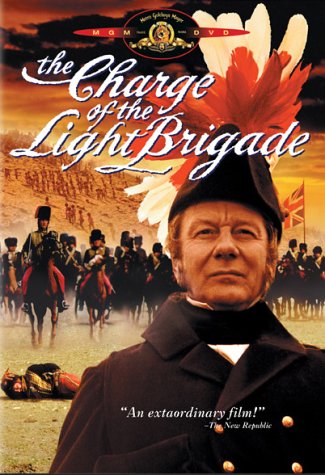
Charge of the Light Brigade

I just finished watching the 1968 film production "Charge of the Light Brigade", directed by Tony Richardson. Beautifully filmed, it's a very odd movie, and of course with it's strongly anti-war sentiment it's bloody and shows battle to be ugly business. Unfortunately it's also very disjointed and quite hard to follow. I actually know what is supposed to happen and when, but even then it's hard to figure out just who is who and doing what and why. Small wonder then that the critics, who Richardson had blasted as "intellectual eunuchs", panned the film. But the worst of the travesties committed by Richardson in this film was that he insisted, for "creative purposes", to fly in the face of all of his advisers and put ALL of the British Light Cavalry, not just the 11th Hussars, in "Cherry Pickers" or "Cherry Bums" trousers. The 11th Hussars were the only regiment in the British Army with crimson trousers (everyone else wore blue), and thus really stood out in a crowd. But for whatever "creative" reason Richardson had, he insisted that ALL of the British Light Cavalry be so attired. Didn't make the members of any of the other regiments who had supported the making of the film very happy, either. Oh well. Interesting film to watch, even though it's often painful at times to endure.

The reason for my watching it is that I just picked up a new book on the subject, entitled "Into the Valley of Death: The Cavalry Division at Balaklava 1854" by none other than John Mollo (with his brother Boris), the gentlemen who had done so much of the research on the uniforms worn by the British forces at the time. So the research did at least result in a fascinating book, well illustrated not only with original paintings and photographs but also modern interpretations of the uniforms as well. Of note are the many sketches drawn on the spot by the French General Vanson, now housed in the musée de l'armée in Paris. Those sketches themselves are worth the price of the book, actually.

At any rate, John Mollo does rant a bit about Tony Richardson's handling of things in his forward, which definitely made me want to watch the film. Alas, though beautiful, it is disappointing in the end. Too bad, it had huge potential.

On the other hand, it has enthused me further to complete my own studies on the dress and accoutrements of British Hussars of the period. So on I go, delving further and further into the quicksand of research, from which hopefully I shall emerge eventually not only unscathed but fully dressed, armed and accoutred as a Serjeant of the 15th (King's) Light Dragoons (Hussars) in a few month's time!

Cheers!

Gordon

Monday, March 23, 2009

Cavalry, Dragoons and Light Dragoons Pt. II

To continue with our discussion of below...

Okay, now move forward 20 years, with the formation of the new Regiment of Dragoons for the US Army (under legislation submitted by none other than Richard Mentor Johnson, Representative for Kentucky). Although they were officially always referred to as "Dragoons", there is a constant unofficial reference to them as "Light Dragoons", and this is also to be seen in their uniforms, arms and accoutrements. The dress uniform of the US Dragoons was almost a line-for-line copy of the British Light Dragoons (as opposed to the "Heavies"), and in the "stable dress" of the American Dragoon it was even closer a match. They even copied the saber issued to British troops, as the US Model 1833 Dragoon Saber is almost identical, with the exception of the hilt being of brass rather than of iron, to the British Pattern 1822 Light Cavalry Saber. The only real difference between the two when you get down to it is that the US Dragoons were armed with a rather revolutionary new carbine, the Hall's Breech-loading Carbine Model 1833, while the British Light Dragoons were still being issued the older flintlock pattern dating from the Napoleonic Wars. This new Hall's Patent Carbine DID have one rather interesting aspect to it (other than the rather novel breech-loading apparatus), it had a cleaning-rod/bayonet arrangement fitted to the underside of the barrel. That it was awfully spindly suggests that it was only there for emergencies, and it didn't last past 1840, so I don't suspect that it was considered either successful nor particularly useful, or perhaps even needed. But it does suggest that there was SOME attempt to make the Dragoons serviceable on foot, so they weren't completely bound to their saddles.


Another regiment of Dragoons was formed in 1836, and bound for the Seminole War in Florida at that time. They got some horses, but spent much of their time dismounted. In fact, they were dismounted as a regiment in 1842 and "converted" to a Rifle Regiment. But that didn't last long as they were remounted some two years later, and never gave up their horses after that. But in 1846, on the verge of the Mexican War, Congress actually acknowleged that there may be some use for such troops as the Volunteer Mounted Rifles being raised in the Southern states as well as Texas, and authorized the formation of the Regiment of Mounted Rifles. Sadly this regiment during the war only had two of it's companies mounted, the rest of them were, in fact, a rifle regiment. To that effect, when Winfield Scott paraded into Mexico City after it's conquest by American troops in September of 1847, he refered to them as the "Brave Rifles!", a motto which they retain to this day.


Yet again however, we discover that these "Mounted Rifles", once they were actually issued horses for their service on the rapidly expanding Frontier, found themselves reticent to relinquish them for combat on foot, just as their ancestors had done in the years and centuries previous. Time after time we find the Mounted Rifles in combat with the local indiginous population of the Plains being mounted, rather than being some sort of Mounted Infantry. It's a curse.


In 1855, Secretary of War Jefferson Davis convinced Congress to authorise two new mounted regiments to help ease the burden that had fallen on the shoulders of the three older regiments in policing the Far West. Experiments in mounting up Infantry and issuing them revolvers and rifles were only marginally successful, as they usually ended up being mounted on either broken-down ex-Dragoon horses or mules, neither of which were known for being able to catch up with Indian ponies in a pursuit. But these new regiments were to be mounted on blooded Kentucky horses and armed with the latest weapons available, and so they were. In fact the 2nd Cavalry was so doted upon by the Secretary of War that they were referred to as "Jeff Davis' Pets". Not too far from the truth, with their Colonel being Albert Sidney Johnston and the Lt. Colonel being Robert E. Lee, both to rise fairly high in fame a few years later. These were raised specifically as CAVALRY though, with no thought at all to their having to dismount at all during combat.


When the Civil War did finally roll around, Congress actually took stock of the situation as it stood and made sense of it finally: ALL of the Mounted Regiments were converted in name, as well as function, to Cavalry. The First Dragoons as senior became the 1st Cavalry, the Second Dragoons became the 2nd Cavalry, the Mounted Rifles became the 3rd Cavalry, the First Cavalry became the 4th Cavalry, and the Second Cavalry became the 5th Cavalry. Congress, in a fit of generosity also provided for a 6th Regiment of Cavalry. Thus after all these years, name and actual function finally came together in one place, and all of the various US Mounted Regiments were designated Cavalry, as they had acted as from the beginning.


Of course the final irony of it all is that during the course of the American Civil War, mounted troops more and more began to act as true Dragoons and less as true Cavalry as they years went by. Frontal saber charges were noted to be singularly suicidal in the face of rifle-musket fire, while the mobility and extra firepower of mounted units, especially when armed with breechloaders such as the Sharps, or better yet magazine carbines such as the Spencer came into play. So finally, the US Dragoons and Mounted Rifles become Cavalry in name as well as function...only to become morphed into true Dragoons for the first time! Amazing stuff, this...


So next time you read someone pontificating about how the US Dragoons were "trained to fight on foot as well as on horseback" remember that yes, they WERE trained on foot before they were allowed to mount their horses. ALL horse troops were trained like that, and the US wasn't the vacuum that most writers think it was. But more, remember that the US Dragoons were in fact LIGHT DRAGOONS, and fought far, far more often from the hurricane deck of their mounts than they ever did on their own two feet. They were Light Dragoons, By God, not some sort of Mounted Infantry! Until the later years of the Civil War, that is...


Cheers!


Gordon

Cavalry, Dragoons and Light Dragoons

While I'm on the subject of Dragoons and what not, I thought it an apt time to discuss one of my pet peeves: the complete incomprehension of most modern military writers to understand just what in the heck a "Dragoon" is.

If you crack open a book or a web-page on cavalry (especially American cavalry) you will soon discover the term "Dragoon", and of course the author will make an attempt to define this rather unusual term for the reader. Usually they take it straight out of a dictionary, without ever bothering to check to see if the definition they've chosen to spout is in fact the proper definition for the era which they are writing about. What doesn't seem to be a commonly understood phenomenon is that terms change in their definitions over the years, and while they may mean one thing in one century, often as not mean something quite different in another. Thus the massive confusion.

In the early 17th Century, a "Dragoon" was the proper definition of Mounted Infantry. They were armed as Infantry, with an arquebus/caliver/musket and infantry accoutrements (such as a bandolier of chargers, etc.), were organized as Infantry with corporals, sergeants and ensigns, and acted like Infantry in the field. The only thing they did with horses was to ride to the battlfield and then dismount to carry on their activities. Dismounting one's Harquebusiers/arquebusiers á cheval was certainly commonly done, and the archers of the Kings of England were often mounted on nags for their Chevaucheé's, but as for orgainising mounted infantry on a large scale, the tip of the hat must go to the Admiral Gaspard de Coligny in the French Wars of Religion. He wanted to give some serious infantry firepower to his Cavalry-heavy armies as well as do something useful with his otherwise surplus numbers of Shotte. His successor in the Protestant Cause, Henri de Navarre, later Henri IV of France, followed this lead with his "Equestrian Army" (see the article "All the King's Horsemen" by my old friend Ron Love in the 16th Century Journal, 1992.) By 1600 this was well established, and as such was much discussed by military writers such as Sir Roger Williams, Johan Joachim von Walhausen and John Cruso. In the 30-Years War and the English Civil War they were an important part of any army in the field, both for scouting and skirmishing, but at times also taking part in Cavalry actions.

This seems to be a standard process, in that Mounted Infantry has a strong tendency to try to "improve their status" by doing less and less Infantry, and more and more Mounted as the years go by. There is a distinct disinclination to dismount and fight on foot, at least until another war comes along and the need is appreciated by all and sundry. Then, often as not, yet another new corps of "Mounted Infantry" is raised, and the old Mounted Infantry (by whatever name) gets to be Cavalry.

By the beginning of the 18th Century this trend was pretty obvious, and many of the European powers (such as Russia) had completely disbanded their "Horse" (i.e. "real" Cavalry) and converted all to Dragoons. The English followed suit in the early years of George 1st, interestingly enough because Dragoons cost less to operate than Horse. Thus, with the exceptions of the Household Cavalry, all British mounted units were now Dragoons, Dragoon Guards, etc. With the change in status, there was also a minor change in organization. Here to fore, Cavalry NEVER had a rank known as Sergeant. They had Corporals, and not many of them. Cavalrymen were the elite, and were understood to not need as much babysitting as Infantry were, thus the lack of need for such a rank. Besides, Sergeants were originally there to impose order in the ranks, and not simply discipline. Order as in, Ranks and Files. So along with the new lower status, Cavalry now received a new rank, Sergeant. (You can tell a "Real" Horse unit in the British Army, as they have Corporal, Staff Corporal, Quartermaster Corporal, and even Company and Regimental Corporal-Major, all of which rank with [or above, since they're Household Cavalry] the Line NCO's.) If you hear of a Sergeant of Cavalry, well, he isn't REAL Cavalry, but from a one-time Dragoon regiment.

Since only the ranks, pay scales and names had changed (though the poor Dragoons were now encombered with rather long muskets to use for carbines as well, though otherwise they were equipped as Heavy Cavalry), there was a perceived need for, guess what, someone who would actually perform scouting and screening duties. Thus by the 1750's the Light Dragoons were invented, the first in British service being the 15th (King's) Light Dragoons. They were followed shortly by the 16th and 17th, and some of the earlier Dragoon regiments were later converted as well. On the Continent, the same need was felt, but rather than coverting Dragoons they formed new regiments based upon the rather flamboyant irregular troops employed by the Austrians in the form of the Hungarian Hussars. The duties were the same, the names and uniforms were, however, different. These Light Dragoons performed yeoman service in the American War/American Revolution, and were of course copied by the American forces in the form of such units on the Patriot side as the 1st-4th Light Dragoons, and on the Loyalist side by the British Legion Light Dragoons. They were armed with light carbines, swords and pistols, just like the "real" Cavalry of the English Civil War, sans some armour. But they were termed now "Light Dragoons".

By the Napoleonic Wars, the Hussar rage was riding quite high, and several of the British Light Dragoon regiments managed to, by one means or another, get themselves renamed "Hussars". Some (like the afore-mentioned 15th) were still Light Dragoons, but added Hussars to their name, as in "15th (King's) Light Dragoons (Hussars)". When the War of 1812 erupted between the US and Britain, the US was, of course, sans any Cavalry of any meaningful kind, and had to raise most of them from scratch. They fell back upon the older scheme of Light Dragoons, but for Volunteers, often as not the horsemen were rather termed "Mounted Rifles", as they were expected to do exactly what Dragoons had originally been formed to do: ride into battle, dismount and then fight on foot, in this case as Light Infantry/Rifles. One such unit, Richard Mentor Johnson's Kentucky Regiment of Mounted Rifles did a stellar job as such. However at the Battle of the Thames in 1813, one squadron of the Kentucky Mounted Rifles under Johnson's brother James did the standard switch: they remained mounted, and performed a charge against the 41st Foot and scattered them. The most interesting part of this was that tactically it was brilliant, as the 41st Foot was expecting them to dismount since they had no sabers, and was thus arrayed in skirmish order. James Johnson on the other hand ordered his men to "Draw Tomahawks" and charged them with tomahawks in hand, riding over them and smashing them, winning the battle.

More Later...

Sunday, March 22, 2009

Cavalry, Dragoons and Hussars

Been WAY too long since I last posted. Sorry to all who check this blog occasionally, if anyone ever will again! Sorry about that...

Anyway, last November we hosted a nice little "Civil War Cavalry Camp" here at Tilbury, mostly to accommodate a couple of friends who want to get back into it. Of course they didn't show, but my other friends who usually do Mediaeval and Renaissance equestrian activities did. And what was most astonishing, they showed up in Civil War uniforms, no less! Bully for them, I was impressed with their industry in doing so. Also friend Stewart who generally does British Engineers came over as well, dressed to the nines in his Victorian "undress" officer's kit. Very nice!


Since then I've been delving back into my studies of the American Civil War and most especially the years leading up to that conflict, mostly in the West. I got into contact with a gentleman who runs the living history program at Ft. Steilacoom, near Tacoma, and thus I've thrown myself headlong into a study of the various Indian-European conflicts in Washington state. And of course even though Ft. Steilacoom was entirely garrisoned by Artillery and Infantry troops, I HAVE to do a Dragoon impression. I even found that there was an ill Dragoon in the fort infirmary during the inspection of 1853, so I think I'm safe in portraying a transient courier from Ft. Vancouver. So here I am portraying a Dragoon from the 1st United States Regiment of Dragoons, ca. early 1850's.

Of course, throwing myself headlong into the 19th Century like this wouldn't be complete without my branching out a bit too. So the afore-mentioned Stewart has somehow maneuvered me into getting rather interested in his own group to study, the Royal Engineers Columbia Detachment. The "big event" to date for the RECD fellows is presently the Pig War event on San Juan Island in July. This year is the Big Year, the 150th Anniversary of the militarization of SJI by the forces of the United States and Great Britain over who owned the San Juan/Orcas islands. The treaty of 1846 merely stated that the boundary between the US and British Columbia was to be along the 49th Parallel, and then through the shipping channel between the mainland and Vancouver Island. The question of course was "which one?" Several channels there, and of course each country chose the channel that best suited it's interests. Things came to a head over the shooting of a Hudson's Bay Company pig by an American settler, thus "The Pig War".

Now, before you start thinking that I've gone stark, raving mad in that I'm actually pondering the idea of picking up a spade and portraying my Irish roots with a will, forget it. As it turns out, the Royal Engineers Columbia Detachment, under Colonel Moody, was supplied with not only Engineering troops ("Sappers"), but also two men from the Royal Artillery, and interestingly enough two Non-commissioned Officers from the 15th (King's) Light Dragoons (Hussars)! Col. Moody thought it might be necessary to organize and train loyal subjects of the Queen as militia cavalry to combat the American Juggernaught, thus the two Cavalry NCO's. Never mind that British Columbia is hardly what one might consider "cavalry country", but still, there they were. And there it is, then! So now I can with a clear conscience portray a Hussar in the wilds of the Oregon Country! Amazing stuff, what?

So now off into the wild and woolly world of researching into the details of just what on earth these fellows may have worn to British Columbia. Would they look like they just got off the boat from the Crimea two years before? Or would they have fully adopted the new clothing and equipments of the regulations published in 1856, just two years prior to their sailing? Ah, the joys of research! It ought to be rather interesting, and it should fill my time rather nicely, I shall presume. Wish me luck!

Gordon

Monday, April 14, 2008

Actions of the Lowe Countries

I just (well, a week ago) returned home from my adventures in California attending the School of the Renaissance Soldier:Actions of the Lowe Countries IV, which was held at Gibson Ranch Park just outside of Sacramento. It was founded four years ago by myself and Patrick Gaul (who is the present Muster Master of the event), based upon a concept by Nick Worthington. We had participants from not only up here in Washington State, but also from Wisconsin and even one hearty fellow who flew out from Massachusetts! I had driven down hauling the horses with my squire and protege, while wife, pard and a compadre flew down. It took us two days to drive, took them about two hours to fly. Hmmm...

The School of the Renaissance Soldier was designed as a means of gathering together as many like-minded individuals and groups as possible in a single setting to practice the military arts of the 16th and early 17th Centuries, something usually not possible with the small groups generally the norm in reenacting circles. We have thus managed to muster some pretty impressive numbers of both Pike and Shotte, actually sufficient to be able to form a "Square" of Pikes with "Wings" of Shotte around them. My own endeavour in this has been to experiment with 16th and 17th Century drill and tactics with Horse, both Heavy and Light. Although we're not quite up to critical mass on numbers of Horse, never the less we've all gained experience over the years with our experiments, and had LOADS of fun with it!

We tried out two new experiments this year with Horse. First was from the beginning to separate the Light from the Heavy Horse. Since Light Horse is primarily for scouting, harassing and otherwise annoying the enemy, I felt that they should do just that. Under the skilled hand of Corporal Berg, that's exactly what they did. The Heavy Horse, under either myself or Cornette Thompson, practiced the fine art of keeping a straight, steady Line of Battle at all gaits in readying for The Charge. LOTS harder to do in practice than in theory, I might add. We also practiced various maneuvers which would bring us from Column of March to Line of Battle at various gaits. Wheel's, Into Line's, About's etc. were practiced and eventually all got the hang of it. Saturday was pretty grueling, but we survived. Sunday was great, and we combined to practiced the "Charge Foote" while Foote responded with "Charge for Horse! Present Carrots!" whereupon we took all of the horses through the infantry ranks, while the infantrymen held out carrots to their four-footed friends. It was very useful in sacking out the horses in preparation for the Tactical later in the day.

The second major experiment was to attach a unit of Dragoons to the Horse. All of the Dragoons wrangled together (under "Reformado" Nick Worthington) had been cavalrymen at earlier events, so I had no problem with the fiction of them being mounted infantry. We of course didn't have sufficient horses to allow them to ride into the field, dismount and fight on foot, but it wasn't a stretch of the imagination for us. Nick outfitted his small detachment with caliver and carabine, with a border-lance performing the duties of a half-pike. The Dragoons performed very well, and gave both the Horse something solid to rally upon after being recalled from their Charges against the Foote, and it gave the Foote something somewhat less fluid than the Horse to maneuver against. It was a very successful experiment, and I anticipate a great deal of discussion and effort being put into putting together something somewhat more permanent for the future than the rather ad-hoc formation we enjoyed. It certainly gave a great deal of credence to the opinions of Sir Roger Williams, the Admiral Coligny and J. J. von Walhausen during the period!

I'm sure that over the next few weeks I'll be discoursing at length on these various things, so stay tuned (or not, as the case may be.)

Allons!

Gordon

(photos in this entry by Neb, Patrick Gaul, Zephram Gomez, Peter Nelson and Nathan Barnett)